
Mushrooms in Lawn: Causes, Risks, and What to Do Next
Learn why mushrooms appear in lawns, which clues suggest routine decay versus safety risk, and what to document before removing them.
Quick answer for mushrooms in lawn
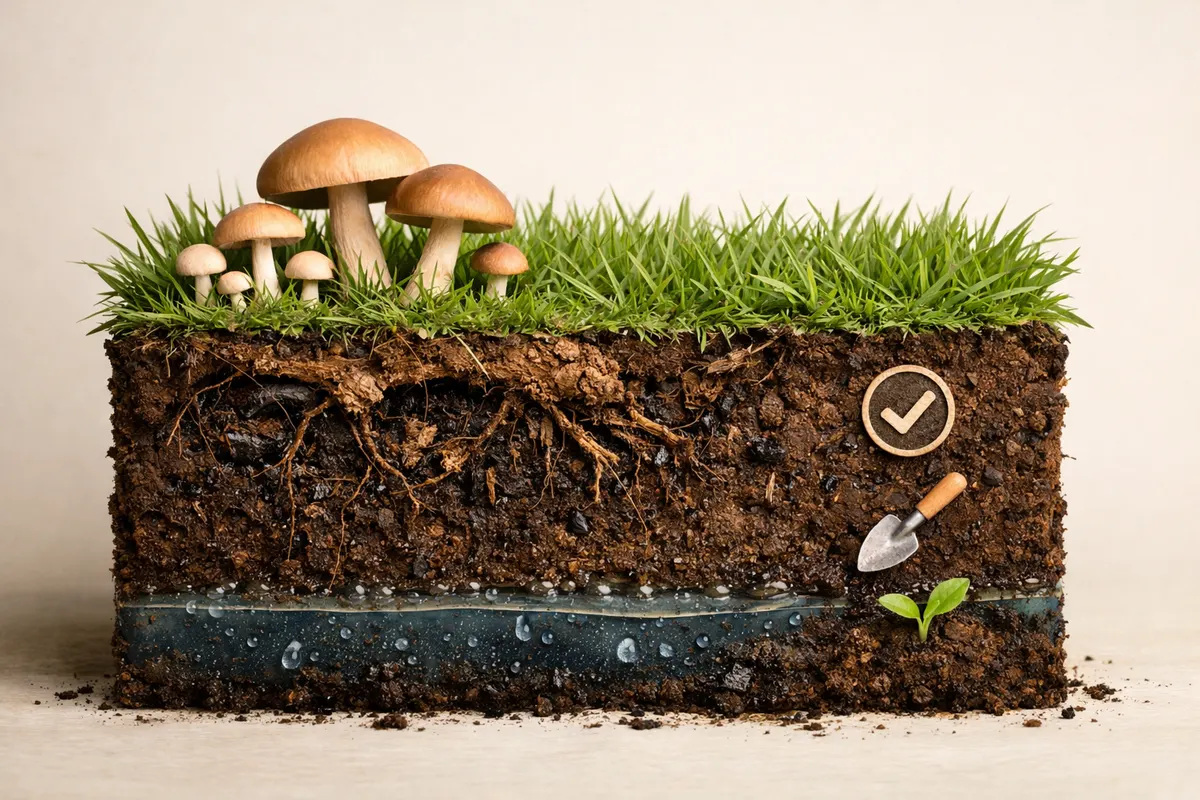
Mushrooms in lawn are the visible fruiting bodies of fungi growing on or under the soil, usually feeding on organic material such as decaying roots, buried wood, or thick thatch. Seeing mushrooms doesn’t automatically mean your grass is dying — many species are decomposers that recycle material and show up after rainy or irrigated periods.
Some lawn mushrooms can be toxic to people or pets, so treat unknown mushrooms with caution. Do not handle, taste, or let children or animals play with them until you know more. If the presence of mushrooms affects safety, planting plans, or property value, document the fungus and habitat clues carefully before removing anything.
Use Fungio (the Mushroom Identifier app) as a first pass to record clear photos and habitat notes, then verify uncertain or risky identifications with local experts or poison-control resources before touching or removing the fungus.
What it means
When you see mushrooms in your lawn you’re seeing the reproductive stage of a fungus. The mushroom cap, gills or pores, and stem are designed to release spores — not to feed the plant. The living organism (mycelium) is usually hidden in soil, thatch, or under rotten wood. In many cases the fungus is helping break down organic material rather than attacking healthy turf.
Common reasons for mushrooms appearing include wet weather or irrigation, shaded lawns with slower drying times, buried wood (from roots, construction debris, old tree stumps), thick thatch that holds moisture, and recent landscape changes that increase organic matter. Some fungi form fairy rings that can temporarily change grass growth patterns; others grow in clusters on decaying wood.
Finding mushrooms does not by itself diagnose a lawn disease. Some species are saprotrophs (decomposers), some are weak parasites that can eat stressed roots, and a few form beneficial partnerships with plants (mycorrhizae) — although those are less common in mowed turf. The proper response depends on the species, substrate, and how the lawn is used (children, pets, food plots).
Key clues
For lawn mushrooms, the strongest clues are not just color or cap shape. Substrate, growth pattern, underside features, stem base, and recent moisture explain why the mushroom appeared and whether the next step is simple removal, monitoring, or expert verification.
- Substrate: Are the mushrooms growing from soil, from a visible patch of wood or stump, or from thatch/grass clippings? Mushrooms on buried wood usually indicate a wood-decaying species.
- Growth pattern: Single caps, scattered individuals, clusters, or a circular ‘fairy ring’ — pattern helps narrow likely groups.
- Cap shape and texture: Convex, bell-shaped, flat, scaly, slimy, or fibrillose textures are helpful visible markers.
- Underside features: Gills, pores, teeth, or smooth undersides — photograph the underside without disturbing too much.
- Stem and base: Presence of a volva (cup at the base), ring on the stem, or root-like rhizomorphs; these features matter for distinguishing dangerous lookalikes.
- Spore color: Spores are diagnostic for many groups. If safe to do so, a spore print can be made later; visually, dark versus light-looking spore dust under the cap can also hint at spore color.
- Season and recent weather: Many lawn fungi appear after heavy rain or prolonged moisture. Temperature and season narrow the list.
- Surrounding habitat: Nearby trees, recent stump removal, compost piles, or buried wood increase the chance of wood-associated species.
- Odor and bruising: Some mushrooms have distinctive smells (anise, fishy, honey) or color changes where bruised; note these but avoid inhaling deeply.
- Size and color changes: Note cap diameter and any color changes with age — many species change dramatically as they mature.
Step-by-step workflow
1) Keep people and pets safe. Until you know what the mushrooms are, prevent kids and pets from handling or eating them. Use a temporary barrier (cones, a section of lawn left alone) if the area is frequented by children or animals.
2) Observe and document without destroying evidence. Take clear photos from multiple angles: the cap top, a close-up of the cap edge, the underside (gills/pores), the full stem including the base, and the surrounding habitat (soil, nearby trees, visible wood). Include a scale object like a coin or ruler in one shot. Photograph in daylight and avoid disturbing the base if it looks buried in soil or thatch.
3) Record contextual notes. Log the recent weather (rain or irrigation), lawn care actions (recent overseeding, mulch, stump removal), presence of buried wood or thick thatch, and how long mushrooms have appeared. These habitat clues matter more than color alone.
4) Use Fungio as a first pass. Use the app on your phone to attach photos and habitat notes—treat its suggestions as preliminary. Fungio helps you organize evidence and can point to likely groups, but do not rely on the app alone for safety-critical decisions (medical, property, or edible-use).
5) Decide on removal or monitoring. If the mushrooms are purely cosmetic and the area is low-risk (no small children or pets), you can mow over them to reduce the caps. For safety or nuisance reasons: mechanically remove mushrooms by hand (with gloves and a bag), dethatch or rake to expose and dry the area, remove buried wood or stumps, improve drainage, and reduce excess shade. Chemical fungicides rarely solve the underlying organic substrate that supports the fungus and are generally not recommended for routine lawn mushrooms.
6) When to escalate. If you suspect an aggressive pathogen harming turf roots, see rapid spread despite good cultural practices, or find a cluster of mushrooms resembling known toxic genera with a volva or large ring, contact your local extension service, a certified mycologist, or poison-control center for advice before making major landscaping decisions.
Examples
Example 1 — Small clustered caps after rain: You notice dozens of small, brown-capped mushrooms clustered in one patch a few days after heavy rain. They appear directly over an old buried tree root. Likely interpretation: a saprotrophic wood-decaying species feeding on the buried root. Recommended next steps: document photos focused on the cluster and substrate, then remove the mushrooms if they are in a play area, and plan to remove the buried wood or improve drainage if they recur.
Example 2 — Ring of darker grass with mushrooms at the edge: A circular area of lush or dead grass with mushrooms appearing around the perimeter is a classic fairy ring pattern. Fairy rings can be caused by several types of fungi; they sometimes create a darker ring of more vigorous grass where nutrients are released, or they can stress turf by hydrophobic soil. Recommended next steps: photograph the ring pattern and edge mushrooms, aerate and dethatch the zone, and consider targeted irrigation adjustments. If mushrooms are in high-traffic areas, remove them promptly and keep pets away until identification is clearer.
Example 3 — Large solitary cap with a cup at the base: You find a single large mushroom with a bulbous base and a loose skirt-like ring on the stem. That combination (cup/volva and ring) is a red flag for several groups that include dangerous lookalikes. Recommended next steps: document all angles carefully, keep the area restricted, and consult a local expert or poison-control resource before handling. Avoid home remedies that could increase risk, such as moving the fungus without gloves.
Example 4 — Rapidly dissolving ink-cap in the morning lawn: In early mornings after dew, small white or grey caps that turn black and dissolve (inky caps) often appear on lawns. They’re typically harmless saprotrophs that break down quickly. Recommended next steps: if they’re not in a risky location, leave them to disappear; if they’re a hazard to pets or kids, remove by mechanical means and improve cleanup of grass clippings to reduce future fruiting.
Limitations
Visual identification has clear limits. Many species have lookalikes that differ only in microscopic features, spore color, smell, or subtle bruising reactions. A single photo rarely provides the full set of diagnostic details needed for a confident, safety-critical identification.
Do not infer edibility or toxicity from color, size, or a quick checklist. Some deadly species resemble harmless ones at certain growth stages. Likewise, a photo of one mushroom cannot establish the full ecology — whether the fungus is actively harming roots, simply decomposing buried wood, or forming a beneficial association.
Spore prints, microscopy, chemical tests, and ecological context are often required to narrow identifications to a reliable conclusion. Regional variation also matters: the same-looking mushroom can belong to different species in different continents. For health or legal consequences (suspected poisoning, landscaping disputes, or property valuation), seek verification from certified experts, extension services, or accredited mycologists.
The Fungio app is a powerful tool to collect and organize evidence, but treat app output as guidance rather than final authority. Use it to prepare your documentation for an expert consultation when the identification outcome affects safety, finances, or major landscape decisions.
Related guides
Document lawn mushrooms before removal
Use Fungio to save clear photos of the cap, underside, stem base, growth pattern, and lawn context before you remove the mushrooms. If children, pets, suspected poisoning, property damage, or edible use are involved, confirm the ID with poison-control resources, an extension service, or a certified mycologist.
Take the next step →Frequently asked questions
Are lawn mushrooms poisonous?
Some lawn mushrooms are poisonous, but many are harmless saprotrophs. You can’t reliably determine toxicity from appearance alone. If ingestion is suspected, contact your local poison-control center or emergency services. Keep children and pets away from unknown mushrooms until an expert confirms they are safe.
How should I remove mushrooms from my lawn safely?
Use gloves or a small rake to remove visible fruiting bodies and place them in a sealed bag for disposal. Avoid crushing them with bare hands, and wash your hands after handling. Mechanical removal reduces immediate hazard but doesn’t remove the underlying fungal mycelium if it’s feeding on buried wood or thick thatch.
Will killing the mushrooms get rid of the fungus permanently?
No. Fungicides rarely eliminate the underlying mycelium and are not usually recommended for cosmetic lawn mushrooms. Long-term control focuses on removing the food source (buried wood, stumps), reducing thatch, improving drainage and sunlight, and practicing good lawn care like aeration and balanced fertilization.
What if my dog ate a mushroom from the lawn?
If you suspect your dog ate a mushroom, collect a photo or the mushroom (if safe) and contact your veterinarian or poison-control hotline immediately. Different species cause different symptoms and timelines, so rapid communication with a professional is important. Do not wait for symptoms to appear before seeking advice.