
Mushroom Identification Guide: Cap, Gills, Stem, Habitat, and Spore Print
Learn which visual clues matter in a mushroom identification guide: cap shape, gills, stem features, habitat, and spore print checks to narrow possibilities.
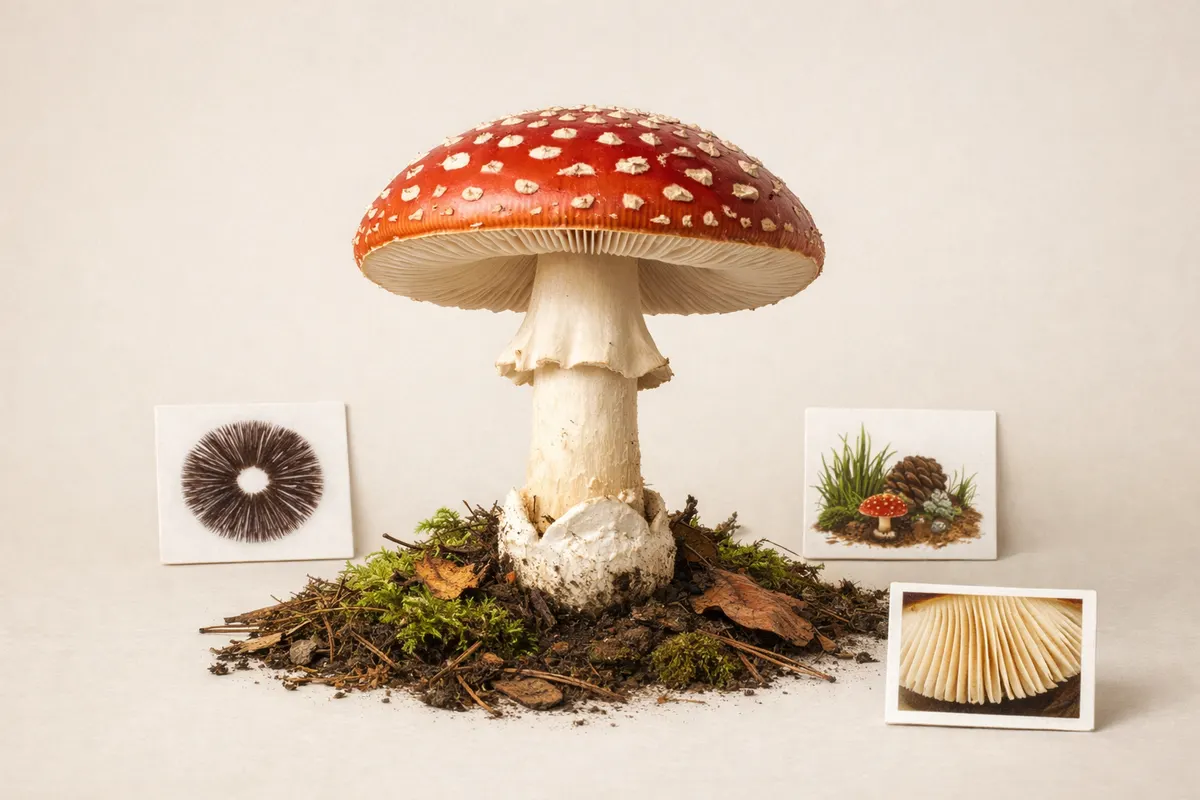
Quick answer for mushroom identification guide
A practical mushroom identification guide starts with a short checklist: cap shape and surface texture, gill attachment and spacing, stem characters (base shape, ring, volva), habitat and substrate, and a spore print color when possible. These clues together narrow possibilities far more reliably than a single color photo.
Not all clues are equally trustworthy. Cap shape, gill attachment, and where the mushroom grows (on soil, dung, wood, or leaf litter) are stable across lighting and angles; cap color and small surface tones shift a lot in photos. Treat a single image as a starting point for comparison, not proof of identity.
If you only take one action in the field, photograph the fungus from multiple consistent angles: top of cap, underside showing gills or pores, stem base and any volva, and surrounding substrate. Combine those images with location notes and season before checking references or using an identification app.
Strongest visual clues
Start with form and attachment: cap shape (convex, plane, umbonate, depressed) and how gills attach to the stem (free, adnate, decurrent) are among the most diagnostic characters you can capture in a phone photo. These structural traits are morphological and hold up across light and minor wear.
Stem base details — a bulb, taper, or an enclosing volva — often separate whole genera. For example, a true Amanita has a distinctive volva and often a ring; a bolete will show pores instead of gills and a stout stem. Photographing the stem base carefully can rule in or out entire groups.
Spore-bearing surface texture matters: gills, pores, teeth, or ridges change which groups are plausible. Fine, close-up photos of the underside will tell you whether you're looking at a gilled mushroom, a bolete with pores, a hydnoid with spines, or a polypore. That single distinction eliminates many lookalikes.
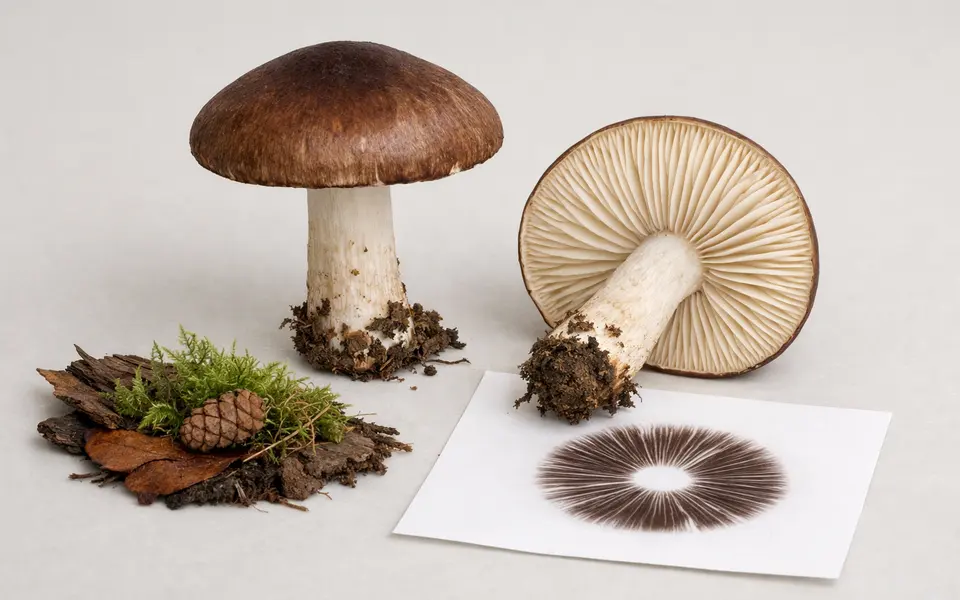
- Cap shape and margin (not just color) — convex, conical, umbonate, or depressed tells genus or group.
- Gill attachment and spacing — free versus decurrent gills, crowded versus distant, can narrow species lists.
- Stem base and volva — bulbous base or sac-like volva often indicates Amanita-related taxa.
- Spore-bearing surface type — gills, pores, teeth, or smooth hymenium directs toward major families.
- Substrate and habitat — wood, soil, dung, and tree association can exclude or include candidate species.
Weak signals
Color alone is a weak signal. Lighting, age, moisture and camera white balance can change a mushroom's color dramatically. Relying on a single hue to label a mushroom edible or toxic is unsafe and commonly leads to misidentification.
Small surface features like faint spotting, subtle zonation, or minor scales are helpful only when supported by structural characters. On wet or decayed specimens these features fade rapidly. Avoid giving them excessive weight if you lack supporting images of the underside, base, or habitat.
Scale and size are often misread in photos without a consistent reference. A common error is estimating cap diameter from a distant shot; always place a coin, ruler, or an object of known size in photos to capture scale. Even then, variability within a species means size should be corroborating, not decisive.
- Avoid using color as the main identifier—shifting light changes hues.
- One-angle photos miss gill attachment and stem base, both critical clues.
- Wet, damaged, or immature specimens can disguise key features.
- Scale guesses without a known reference are unreliable.
Comparison workflow
Work top-down: begin by sorting into broad groups — gilled mushroom, bolete, polypore, coral, agaric with a volva, etc. This removes many unrelated candidates at once. Record the group for every specimen before moving to narrower matches.
Next, compare the strongest clues together. For each field mark, ask whether the candidate species matches the cap shape, gill attachment, stem base, and habitat. Use elimination: if a candidate requires a volva but the specimen has a tapering stem without a volva, remove it from the shortlist.
Use spore print color as a decisive tie-breaker when structural clues leave multiple options. A spore print is straightforward: place the cap gills-down on paper (half white, half black if you can) for several hours in a covered container. The spore color — white, brown, pink, black, olive — often separates lookalikes.
- Step 1: Sort into the correct hymenium type: gills, pores, teeth, or smooth.
- Step 2: Match cap shape + gill attachment + stem base + substrate.
- Step 3: Use a spore print color and smell (careful) as confirming characters.
- Step 4: Confirm seasonal and geographic fit for candidate species before concluding.
App workflow
After you collect multiple photographs and notes, use an identification tool like Fungio to run a first-pass comparison. Start the app with a set of images that show the top of the cap, the underside, the stem base, and the surrounding substrate. Multiple images reduce the chance of algorithmic misread caused by a single misleading photo.
Feed the app the contextual details you recorded: substrate (wood, soil, dung), nearby trees, and approximate location and date. These metadata points steer automated suggestions away from implausible matches and toward species that actually occur in your region and season.
Treat app suggestions as hypotheses, not final answers. Use the app’s candidate list to revisit your field-mark checklist. If suggested matches contradict clear structural clues (for example, a gilled species suggested for a pore-bearing specimen), favor your observed field marks and seek targeted references or an expert verification.
- Collect: top, underside, stem base, close-up of gills/pores, and substrate photo.
- Record: substrate, nearby trees, date, and rough GPS or location note.
- Run Fungio with multiple images and contextual notes for a ranked candidate list.
- Cross-check app suggestions against your strongest clues before trusting a match.
Related guides
Use Fungio after you gather multiple clues
When you have top, underside, stem base, and habitat photos plus notes on substrate and location, run those images through Mushroom Identifier: Fungio for a prioritized candidate list. Treat app suggestions as starting points — compare them to your field-mark checklist and seek verification before making decisions about handling or consumption. Visit https://mushroomidentification. app/ to learn more about using Fungio in your research workflow.
Take the next step →Frequently asked questions
How do I take a reliable spore print in the field?
Cut the cap cleanly and place the gill-side down on half white, half black paper or a glass slide in a covered container to keep drafts out. Leave for several hours or overnight. Note the spore color against both backgrounds; then photograph and discard the sample safely.
Which photos are most important for wild mushroom identification?
Priority photos are: top of the cap, underside showing gills or pores, the stem including the base (dug gently if needed), and a photo of the mushroom in its habitat showing substrate and nearby trees. Include an object for scale.
Can I identify edible mushrooms from a single good photo?
No. A single photo can suggest possibilities but cannot confirm edibility or toxicity. Edibility requires cross-checking multiple field marks, spore print color, habitat, season, and often microscopic or chemical tests plus authoritative verification.
What should I do if an app and a field guide disagree?
Trust verifiable field marks first: hymenium type, gill attachment, stem base, and substrate. Use the disagreement to refine your photos and notes, then consult a regional expert or community mycology group with your evidence rather than relying solely on one source.