
White Mushroom in Yard: Photo Clues, Risks, and Safe Next Checks
Use cap, gill, stem-base, and yard-context photos to assess a white mushroom while treating color-only matches as low confidence around pets.
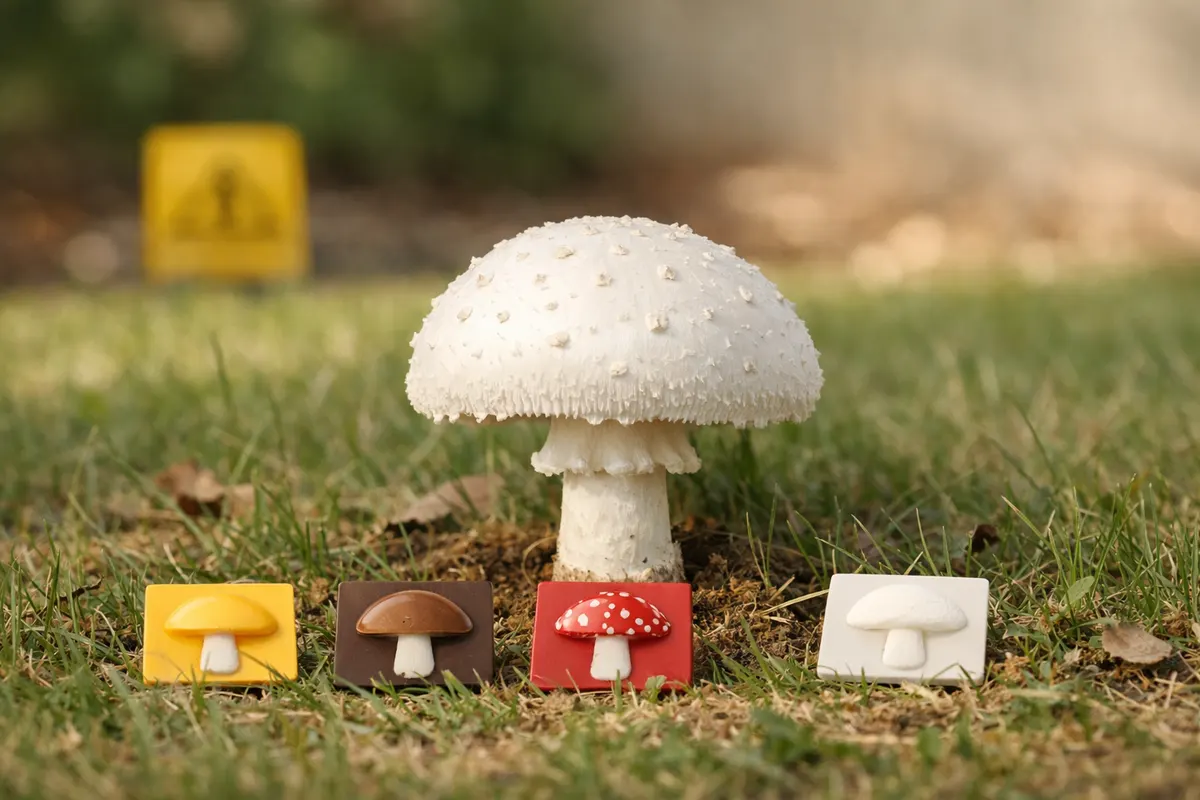
Quick answer for white mushroom in yard
Seeing a white mushroom in yard is common and can mean many different species — some harmless, some irritating, and a few that are dangerous. Color alone is a poor basis for any safety decision. Instead, focus on a short list of stable, visible clues that survive glare, distance, and typical phone-photo quality.
The most useful visual clues for a white mushroom in yard are cap shape and texture (smooth, scaly, or sticky), gill attachment and spacing (crowded vs. distant, free vs. attached to the stem), stem features (ring/veil remnants, base shape, any bulb or cup), and context in the yard (growing on turf, mulch, wood, or near tree roots). Combine these clues; a single trait rarely narrows an ID to one species.
If your goal is safety around children or pets, treat any white mushroom in yard as a low-confidence unknown until you can compare multiple visual clues or get expert help. Use photo-based comparison tools like Fungio to shortlist candidates, but do not rely on a color-only match to decide whether something is safe to touch or ingest.
- Treat white color as a weak clue until cap, gill, stem, base, and habitat details support it.
- Most useful clues: cap shape/texture, gills, stem features, and substrate/habitat.
- Safety rule: treat color-only matches as low-confidence and act conservatively around kids and pets.
Strongest visual clues
Cap shape and surface texture are among the most reliable clues visible in phone photos. Note whether the cap is convex, flat, bell-shaped, or has a pronounced umbo (a central bump). Surface texture — smooth, fibrillose (hairy), scaly, cracked, or slimy when wet — narrows candidates. For example, many white Amanitas show a smooth white cap with wart-like volval remnants in mature specimens, while Coprinus-type species often have delicate, inky caps that change rapidly.
Gills and their attachment to the stem are a repeatable feature you can often capture with a close phone shot beneath the cap. Look for gill spacing (crowded or distant), color (white, cream, pinkish, brown as spores mature), and whether gills are free from or attached to the stem. Free white gills plus a ring and a volva at the base are classic red flags for some toxic groups; crowded gills that darken to black indicate inky caps.
Stem characteristics matter: presence and position of a ring (annulus), any remnant veil across the cap edge, stem texture (smooth, scaly, striated), and importantly the base. A bulbous base, sac-like volva, or cup-like structure is an identification-critical detail for several dangerous white species. When possible, gently expose the base in photos — but do not dig if doing so risks injury or spreads spores into your lawn.
Substrate and ecological context are high-value clues. Is the mushroom growing directly from grass, a buried stump, wood chips, a living tree root zone, or the soil near deciduous trees? Many white lawn mushrooms are saprotrophic on grass or mulch (e. g. , Marasmius, Leucocoprinus), while others that grow from buried mycorrhizal connections or from a universal veil remnant may signal different groups. Note season and recent lawn treatments — fertilizer, new mulch, or irrigation changes can trigger flushes of particular species.
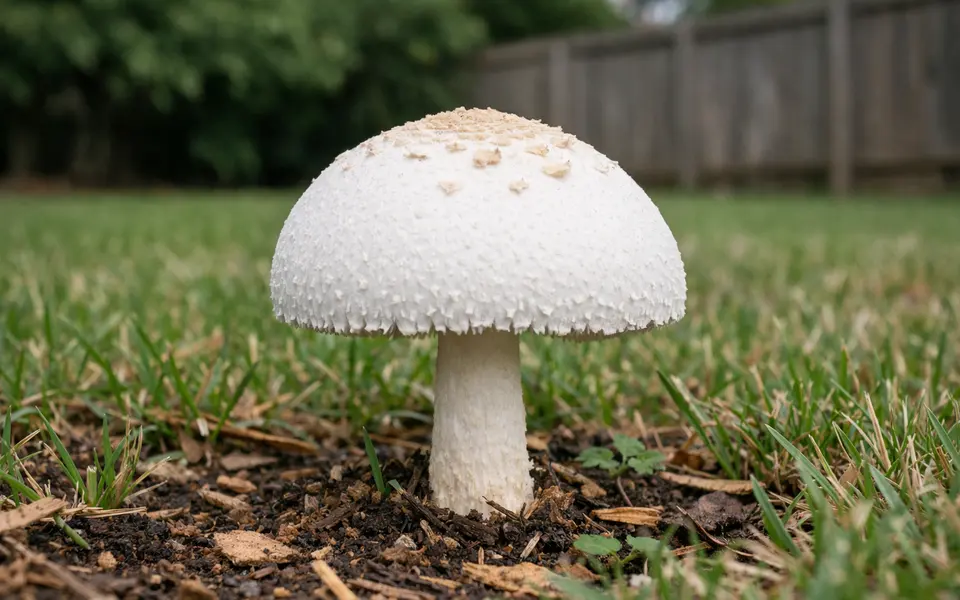
- Cap: shape (convex/flat/umbonate) and surface (smooth/scaly/slimy) are durable clues.
- Gills: attachment (free/attached), spacing, and color progression are consistent photo targets.
- Stem/base: ring, volva, bulbous base, and texture strongly narrow possibilities.
- Substrate/ecology: grass vs. wood chips vs. buried wood vs. leaf litter changes likely species.
Weak signals
Color is the most overrated clue for a white mushroom in yard. Lighting, age, weather, and even camera auto-white balance can shift perceived color from white to cream, yellow, or gray. Some species change color as spores mature, or bruise to a different tint when handled, so raw color in a single photo rarely identifies a species.
Size as a single measure is also unreliable unless you include a scale reference. Without a ruler, coin, or known object, words like “small” or “large” are ambiguous. Similarly, one-angle photos hide gill attachment and base features; a top-down view misses the stem ring or volva and can make many different species look similar.
Other tempting but weak clues include proximity to pets or children (which only indicates risk exposure, not species), presence of insects, or a single nearby tree species mentioned without a clear photo of root zone. These can complement a diagnosis but never replace the primary visible clues listed as strong clues.
- Do not rely on cap color alone — lighting and age distort it.
- Size without a scale reference is ambiguous; include a ruler or coin for meaningful context.
- Single-angle photos miss gills, stem rings, and base structures — avoid one-shot conclusions.
Comparison workflow
Work through a consistent, repeatable photo checklist before you trust a shortlist. Start by taking 4–6 photos from these basic angles: (1) top of the cap, (2) side showing cap-to-stem profile, (3) underside showing gills or pores, (4) close-up of the stem midsection and any ring, (5) base of the stem showing any bulb or volva, and (6) the immediate habitat (surrounding grass, mulch, or wood). Always include a small scale item like a coin or key so size is clear.
With those photos, compare groups of features — not just a single trait. Create a mental or written checklist: cap shape/texture, gill attachment/spacing/color, stem ring/veil/texture, base structure, and substrate. Rule out large groups quickly: for example, if gills are black and deliquescing (turning to ink), you’re likely dealing with an ink cap rather than an Amanita-type white species.
Use process of elimination: match at least three independent clues before you consider a candidate a plausible ID. If a white mushroom in yard has free white gills, a ring, and a volva-like basal cup, treat Amanita-group matches with high caution. If the cap is fragile, turning inky, and the gills darken quickly, an inky Coprinus is plausible and less likely to belong to volva-bearing groups.
Keep confidence levels explicit. Label each candidate as high-confidence (3+ matching clues), medium-confidence (2 matching clues), or low-confidence (color or one trait only). For safety decisions — removing from lawn, keeping pets away, or contacting a local extension — act based on the confidence level and use conservative measures when in doubt.
- Take 4–6 standard photos: top, side, underside, stem close-up, base, and habitat.
- Use a scale object (coin, ruler) in at least one photo to fix size.
- Match three independent clues before treating a candidate as plausible.
- Label candidate confidence: high (3+ clues), medium (2 clues), low (1 clue or color-only).
App workflow
After you’ve gathered the standard photos and run the checklist, use the Fungio app to compare visible traits. Fungio is designed to help you compare cap shape, gill patterns, stem features, and substrate from your photos to likely candidates — it’s a research aid, not a substitute for lab tests or a mycologist’s in-person assessment. Treat app matches as a prioritized shortlist, not a definitive identification.
When you submit photos in the app, prioritize mid-range shots that show the gills and the base clearly. If a top-down and underside shot disagree (for example, top looks smooth white but gills show darkening), add the additional angles before finalizing your comparisons. In the app, mark matches you find plausible and tag each with your confidence level. Use the app’s comparison outputs to focus follow-up steps, such as whether to keep pets away or remove fruiting bodies carefully.
A practical rule: if Fungio suggests a match based primarily on white color, downgrade that match to low confidence unless multiple other clues line up. Conversely, if the app shows candidates that match cap texture, gill attachment, and base features, treat those as medium or higher confidence leads and consider local expert consultation for confirmation before doing anything irreversible.
Finally, use the app’s results to choose appropriate next actions. Low-confidence matches: remove visible mushrooms with gloves and place in a sealed bag for disposal, keep children and pets away, and monitor for more. Medium/high-confidence matches that could indicate dangerous groups: contact local extension, poison control (if exposure occurred), or an experienced local mycologist rather than relying solely on app output.
- Fungio is a research tool — use it to shortlist candidates, not to confirm safety or edibility.
- Upload mid-range photos that include gills and the base; include a scale object if possible.
- Downgrade app matches based on color alone; raise confidence only when 3+ clues match.
- Use app findings to decide conservative next steps: isolate, remove carefully, or consult experts.
Related guides
Use Fungio to compare traits — then treat color-only matches as low-confidence
After you gather the standard photos and checklist, use Mushroom Identifier: Fungio to compare visible traits like cap shape, gill attachment, stem features, and substrate. Fungio helps you build a prioritized shortlist so you can make safer next-step choices (isolate, remove carefully, or seek local expert confirmation). Remember: Fungio is a research aid, not a substitute for laboratory or professional verification. Learn more at https://mushroomidentification.app/.
Take the next step →Frequently asked questions
Can I tell if a white mushroom in yard is poisonous just by looking?
No. You cannot rely on appearance alone, especially color, to determine toxicity. Some deadly species can look similar to harmless ones in a single photo. Use multiple visible clues (cap texture, gill attachment, stem base) and treat any uncertain white mushroom as potentially hazardous around children and pets until confirmed by an expert.
What should I do right away if I find a cluster of white mushrooms in the lawn?
Keep people and pets away from the area, take the set of standard photos (top, side, underside, stem, base, habitat) with a scale item, and remove visible fruiting bodies wearing gloves if you need to reduce immediate exposure. Place removed mushrooms in a sealed bag for disposal. Use a comparison tool like Fungio to create a shortlist and consult local experts if the shortlist includes dangerous groups.
Could a white mushroom in yard be just from mulch or compost?
Yes — many white, cream, or pale mushrooms in yards are saprotrophic and feed on decomposing mulch, compost, or thatch. Habitat photos are important: mushrooms arising directly from wood chips or a compost pile are more likely to be saprotrophs, while those clustered near tree roots or buried wood may represent other ecological groups. Habitat is a strong clue but not proof of harmlessness.
How do I photograph the base without harming the mushroom or my lawn?
Gently part the grass or lift a small section around the stem to show whether there is a bulb, cup, or volva. Use a finger to clear debris rather than digging deeply. If the base is tightly buried and exposing it risks damage to your lawn or the specimen, take multiple side and habitat shots instead and note that the base was not visible — then treat the find with extra caution.