
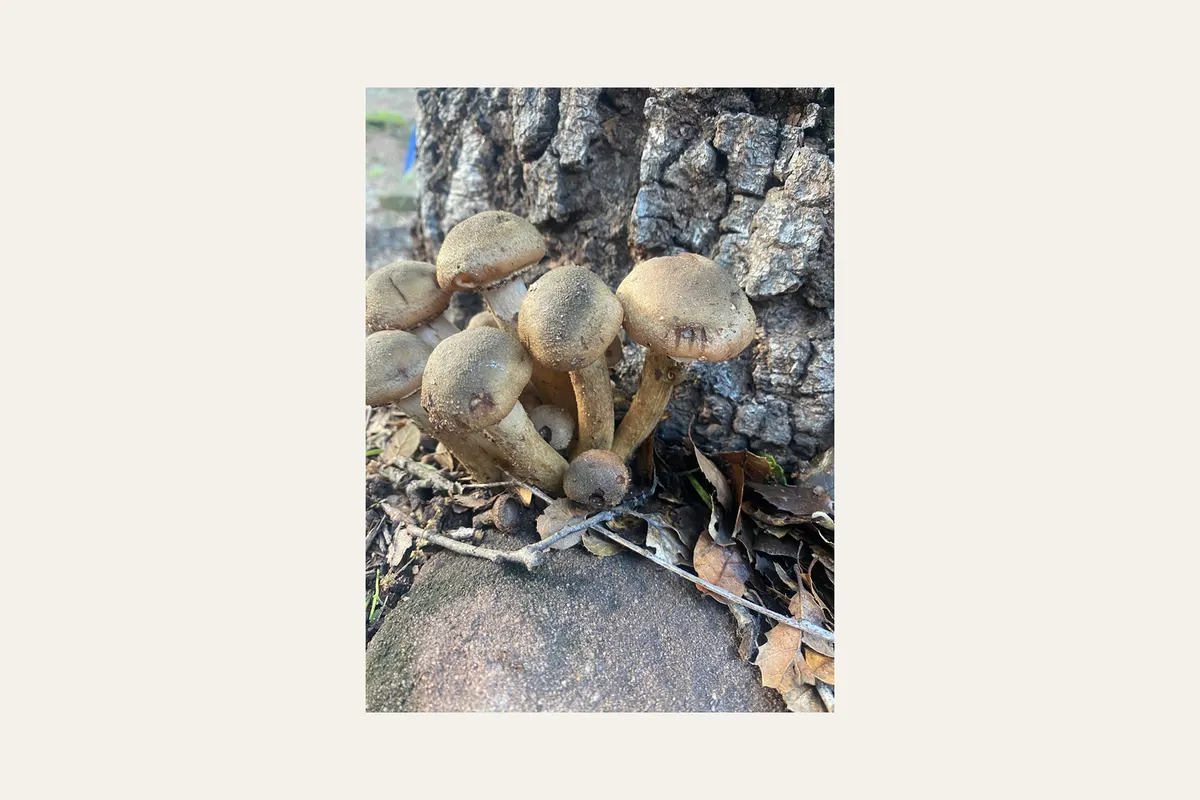
Unconfirmed mushroom cluster; honey fungus suggested
This honey fungus identification example shows a brown mushroom cluster at a tree base. See the visible clues, dangerous lookalikes, and missing evidence.
Identification summary
This honey fungus identification example begins with a photograph of brown-capped mushrooms clustered at the base of a tree. The scan suggested honey fungus, an Armillaria species. That is an unconfirmed candidate: the photograph does not establish a species identification or whether the mushrooms are edible.
Visible features include clustered stems, rounded brown caps, darker surface flecks, and bark immediately behind the group. Some caps show wear or damage. These observations describe this particular image without inventing a spore print, field notes, smell, or microscopic examination.
The underside of the caps and the complete stem bases are not adequately shown. A pale band near one upper stem deserves a closer view, but this image does not document a consistent ring structure across the cluster. Several wood-associated fungi overlap in general color and growth habit. Do not eat mushrooms identified from a photo or an app suggestion.
Evidence
| Visible setting | Cluster at a tree base |
|---|---|
| Cap features | Brown caps with darker surface flecks |
| Missing evidence | Clear underside, complete stem bases, and spore information |
| Edibility | Not established; do not eat based on this image |
Historical context
A useful follow-up set would include the whole cluster, a clear underside view, the full stem including its base, and the actual substrate. Photograph specimens in place where possible. If a knowledgeable local identifier requests a specimen, follow their collection guidance and keep different mushrooms separate. Similar-looking fruiting bodies nearby need not be the same species.
Deadly Galerina is a particularly important comparison because it can also grow on wood and have a brown cap. The Missouri Department of Conservation (https://mdc.mo.gov/discover-nature/field-guide/deadly-galerina) describes its rusty-brown spore deposit, contrasting with the white spores associated with honey mushrooms. No spore deposit is supplied here. A spore color alone is not an edibility test and does not replace full expert identification.
Age, rain, drying, and damage can alter cap color and surface texture. A ring may be obscured or incomplete, and a photograph can conceal fine gill details. That is why a broad resemblance to a honey-colored cluster should remain a working lead, even when an app returns a confident name.
For identification, ask an experienced local mycologist or mushroom identification group to review the complete evidence. Supply the location, date, substrate, and original photographs if you have them. Do not invent those observations from the scan date or the suggested species name.
For tree health, an arborist can assess the tree and roots in context. A mushroom cluster in one photograph cannot establish the extent of decay, the condition of the root system, or whether a tree is structurally safe. The mushroom name and the tree-risk assessment are separate conclusions.
If a person has eaten an unidentified mushroom, seek urgent medical or poison-service advice rather than waiting for online identification or symptoms. Keep available photographs and remaining material for the professionals, without delaying care. A later app match cannot rule out poisoning.
Keep identifying
Read the full category guide for the visual clues behind this identification.
Gilled Mushroom Identification: Visual Clues and Safe Next StepsRelated guides
Have your own gilled mushroom identification identified
Explore Fungio (https://mushroomidentification.app/) for a photo-based mushroom suggestion. Check that suggestion with a qualified local identifier. The result must not be used to decide whether a mushroom is safe to eat.
Take the next step →Frequently asked questions
Does the photograph prove honey fungus?
No. It supports a comparison with clustered wood-associated mushrooms but lacks important underside, stem-base, and spore evidence.
Can a white spore print establish edibility?
No. Spore color is one identification trait, not a safety test. A complete expert identification is still needed.
What should happen after an unidentified mushroom is eaten?
Seek urgent professional medical or poison-service advice. Do not wait for an app result or symptoms.