Gilled Mushroom Identification
Gilled Mushroom Identification: Visual Clues and Safe Next Steps
Compare cap, gill, stem and habitat clues for gilled mushroom identification. Learn what photos can show and when lookalikes need expert review.
Gilled mushroom identification starts by documenting the cap, underside, stem and growing surface. Photos can help narrow possibilities, but some fungi have folds or gill-like structures that are easy to misread. A bracket-shaped fruiting body is not automatically a nongilled fungus, and a visible gill pattern does not establish a species.
Photo identification is the fastest first pass because it converts visual field marks into searchable features: cap color and texture, whether gills are attached or free, stem features such as rings or velvet, and the growth pattern (single, clustered, ringed). Those visible details let an identification tool suggest candidate matches and list which extra photos or tests would increase confidence.
Use the checklist below before submitting a photo so the result can be more informative and selective. Capture the features the app needs and note where a single image will still leave reasonable doubt that requires follow-up checks or expert review.
Do not eat a mushroom on the strength of a photograph, app suggestion or checklist. If someone may have eaten a wild mushroom, contact a poison center promptly rather than waiting for symptoms or an identification. In the US, Poison Control is available at 1-800-222-1222; elsewhere use the local poison service. See https://www.poison.org/articles/wild-mushroom-warning.

How identification works
Step 1
Snap a photo
Take a clear, well-lit photo of your item in the Mushroom Identifier: Fungio app.
Step 2
Get an instant identification
The app reads the visible clues and returns the closest matches in seconds.
Step 3
Review the details
Check the attributes, rarity, and estimated value range before deciding your next step.
Key field marks for gilled mushroom identification
Gills are the defining visual signal: record whether they are attached to the stem, descending the stem, or free. Gill spacing, edge raggedness, and color (including immature vs mature differences) are primary clues that narrow genus-level candidates.
Cap shape and surface finish help separate lookalikes. Smooth convex caps, wavy funnel caps, or scaly caps point toward different groups; note whether the cap bruises or stains when touched. Color, texture and shape are supporting clues; even a combination may leave several possibilities.
Stem details — thickness, hollow vs solid core, presence of a ring, and surface texture — are often decisive. Spore color matters but usually requires a spore print; still, many species have diagnostic stem ornamentation you can photograph.
Habitat and growth pattern close the loop: single stems on soil, clustered on buried wood, or rings (fairy rings) each match different identifications. Record time of year and location ecosystem, because seasonal and substrate preferences are strong filters.
A dark velvety stem on wood can suggest a comparison with velvet shank, but does not confirm it. Wood-growing gilled mushrooms have dangerous lookalikes, so retain uncertainty and seek expert review.
- Gills: attachment (free/attached/decurrent), spacing (crowded vs distant), and color progression.
- Cap: diameter, margin shape, surface texture (smooth/scaly/slimy), and bruising color.
- Stem: ring presence, surface texture, base shape, and interior structure only if already visible; do not infer it from surface feel.
- Context: substrate (wood, lawn, leaf litter), clustering pattern, and nearby tree species.
- Take close-ups (micro-scale detail) and a scale reference like a coin or ruler.
How to interpret a possible mushroom match
Treat a photo result as a set of candidates to investigate, not a confirmed identification or edibility assessment. Compare each proposed name with the field marks actually visible. If a necessary feature is hidden, record that limitation instead of assuming the tool observed it.
The Mushroom Identifier offers a photo-based first pass. It may describe traits, possible lookalikes and next checks, but it does not replace a local mycologist or provide proof that a mushroom is safe. Do not assume that a numeric confidence score, verified reference photographs or a plant-disease diagnosis accompanies the result.
Habitat notes and additional photographs can help an expert, but a spore print, bruising color or stem feature is not a stand-alone safety test. Never taste an unknown mushroom as a beginner’s identification step. A match that looks plausible may still require microscopy or other specialist evidence.
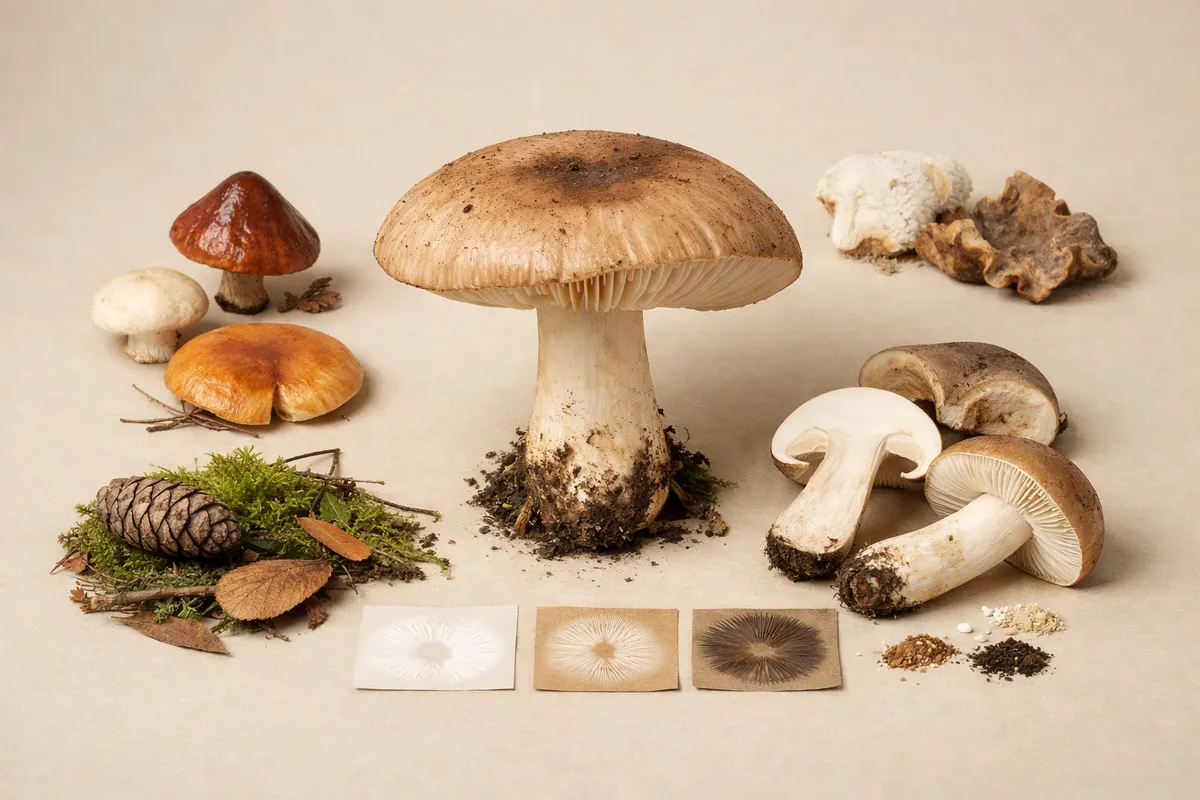
For a broader documentation workflow, see the Mushroom Visual Checklist at https://mushroomidentification.app/blog/mushroom-visual-checklist. Keep generated illustrations separate from documented specimen photographs when comparing details.
- Record the suggested name as a candidate.
- Check which traits are visible and which are missing.
- Compare plausible lookalikes with a qualified local expert.
- Keep identification separate from any decision about eating a mushroom.
Lookalikes most often confused with gilled mushrooms
First describe the underside: thin plates, blunt folds, pores or teeth. Some structures can look alike in a poorly lit image. Photograph the underside and side profile without assuming that a shelf or bracket shape decides the group.
Small brown or white gilled mushrooms include many unrelated species. Gill color, attachment, stem-base details and habitat may help narrow the group, but texture or cap color alone is insufficient. Closely similar species can differ in features that a phone photograph does not show.
Chanterelle-like folds can be confused with true gills. Blunt ridges that fork or connect differ from thin, blade-like plates, but a single underside image may not resolve the distinction. Neither that comparison nor a stem cut should be used to pronounce a mushroom edible.
- Gills vs pores/teeth: underside photos show whether the fungus truly has gills.
- Clustered wood-decay species vs lawn species: include substrate and base-of-stem photos.
- Funnel-shaped gills vs false ridges (chanterelles): observe whether ridges fork and run down the stem.
Frequently asked questions
What photos are essential for reliable gilled mushroom identification?
Essential photos are: a clear top view showing cap shape and surface, a close-up of the gills to show attachment and spacing, a side view including stem and cap profile, and a close shot of the stem base and substrate. If possible, include a scale reference (ruler or coin) and a habitat shot showing surrounding trees or log. These images give the visual field marks needed to narrow candidates and flag what additional tests matter.
How do I confirm honey fungus identification when mushrooms are at a tree base?
Clusters near a tree base do not confirm honey fungus or diagnose root disease. Photograph the mushrooms, substrate and any naturally visible fungal structures without damaging the tree. Identification and assessment of tree health require appropriate expert review; seek an arborist if the tree itself may be unsafe.
Can one photo confirm whether a gilled mushroom is edible or poisonous?
No. A single photo can suggest likely genera but cannot reliably confirm edibility or toxicity. Visual matches can be misleading, and many toxic species closely resemble edible ones. Use photo ID as a first pass, follow recommended follow-up checks (spore print, multiple angles, habitat notes), and consult a local expert before considering ingestion.
What should I note when mushrooms are in tight clusters and I want a better ID?
For clustered mushrooms, document the whole cluster and also take individual fruiting body close-ups showing stem attachment, any stem-rooting, and gill details. Note whether stems are brittle or fibrous, whether caps separate cleanly, and whether the cluster arises from buried wood. Those observations let an identifier distinguish true clustered saprotrophs from separate single-stem species that just grow near each other.
Related guides
Try Mushroom Identifier: Fungio after narrowing the field marks
Use Mushroom Identifier: Fungio at https://mushroomidentification.app/tools/free-mushroom-identifier for possible photo-based matches after recording the visible traits. Treat every suggestion as provisional and verify it with a qualified local expert. An app result is never permission to eat a mushroom.