Mushroom Habitat: Wood, Soil, Grass, and Tree Association Clues
Learn which mushroom habitat details a photo can prove, which it cannot, and the follow-up checks worth doing before you rely on the answer.
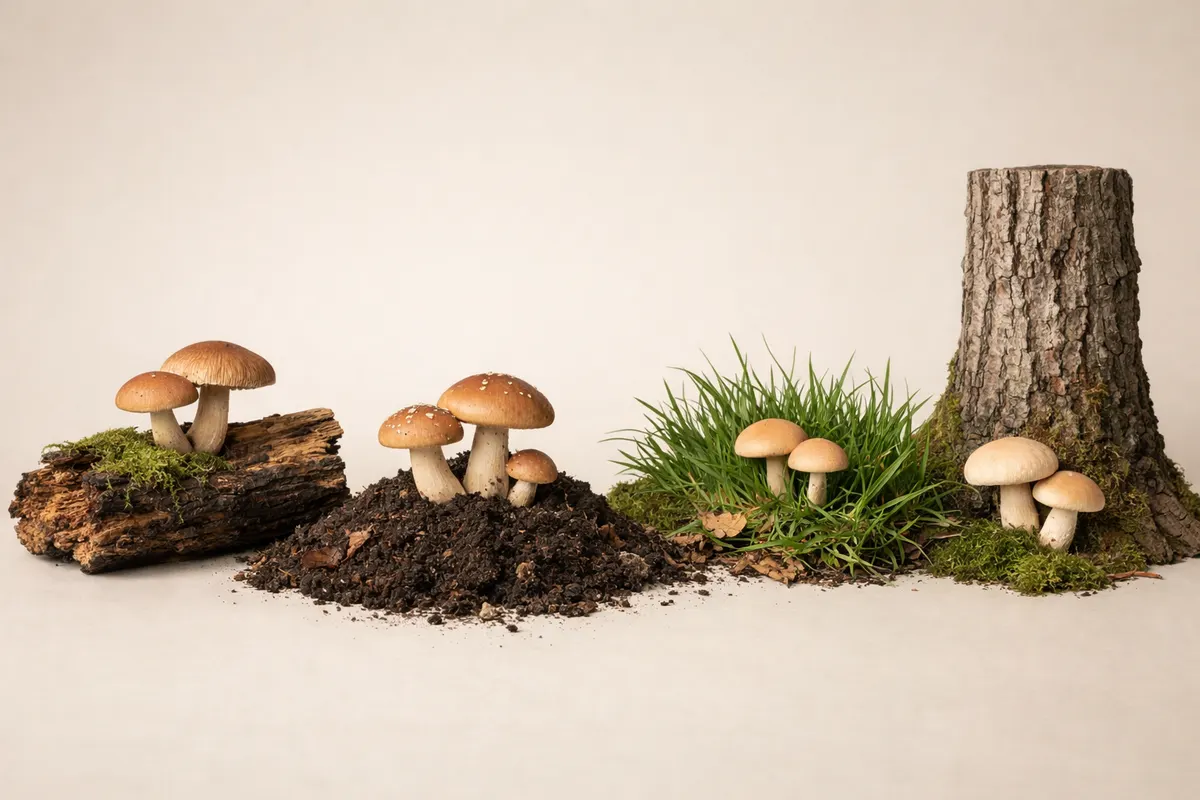
Quick answer: what a mushroom habitat photo can show
A clear habitat photo can reliably tell you three things: the substrate the mushroom is growing from (wood, exposed soil, turf/grass, or leaf litter), the immediate microhabitat (moss, stump, burned ground, lawn), and visible associations with plants or trees nearby. Those observations quickly separate large ecological groups — for example, mushrooms fruiting directly from dead wood are almost always saprotrophs that digest wood, while those clustered at the base of a living tree are often mycorrhizal associates.
However, a single photo rarely proves identity on its own. Habitat narrows the field but does not eliminate lookalikes. Two unrelated species can fruit in the same place (for instance, both mycorrhizal and saprotrophic fungi can appear at the base of a tree if buried wood or leaf litter is present). Treat habitat clues as evidence that raises or lowers probability rather than as a final answer.
Use habitat as your first sorting step: note substrate, plant or tree partners, growth pattern (cluster, ring, scattered), and micro-site details like moss or mulch. These are the strongest clues to record before you compare the specimen to field guides or use a first-pass tool.
- Substrate: is the mushroom attached to wood, on bare soil, inside moss, or in turf?
- Plant association: is it under conifers, under deciduous trees, or in open grass?
- Growth pattern: solitary, clustered, in a ring, or forming dense shelves on a log?
- Microhabitat: stump vs. fallen branch vs. buried root, presence of leaf litter, burned ground, or human mulch
Strongest mushroom habitat clues to trust in photos
The most reliable habitat clue is direct substrate contact. If a cap or stem is visibly attached to wood or growing out of a stump, that observation is strong: the fungus is using wood as its food source. Even when only part of the base is visible, look for frayed wood fibers, exposed decay, or a stem that disappears into bark — those details survive poor lighting and still tell you the substrate.
Tree association is the second-strongest clue when you can identify the tree. Some fungi form specific partnerships with tree genera (pines, oaks, birches). You do not need to be a dendrologist to note obvious signals — visible needles, cones, or broadleaf litter — and pairing that with substrate often halves the candidate list in practice.
Growth pattern and orientation are robust signals that survive most phone photos. Clusters of many stems from one point, bracket-shaped shelves on the vertical face of a log, or a distinct ring in a lawn (a fairy ring) point to particular ecological roles — saprotroph, wood-decayer, or turf-associated species. Those patterns are much more diagnostic than cap color, which changes with moisture and age.
Season and local microclimate matter. A mushroom fruiting in spring in an alder swamp likely belongs to a different set of species than one fruiting on the same stump in late autumn. When photos include context — wet leaves, standing water, fresh frost, or late-season leaf drop — those cues narrow possibilities more reliably than isolated color or size estimates.
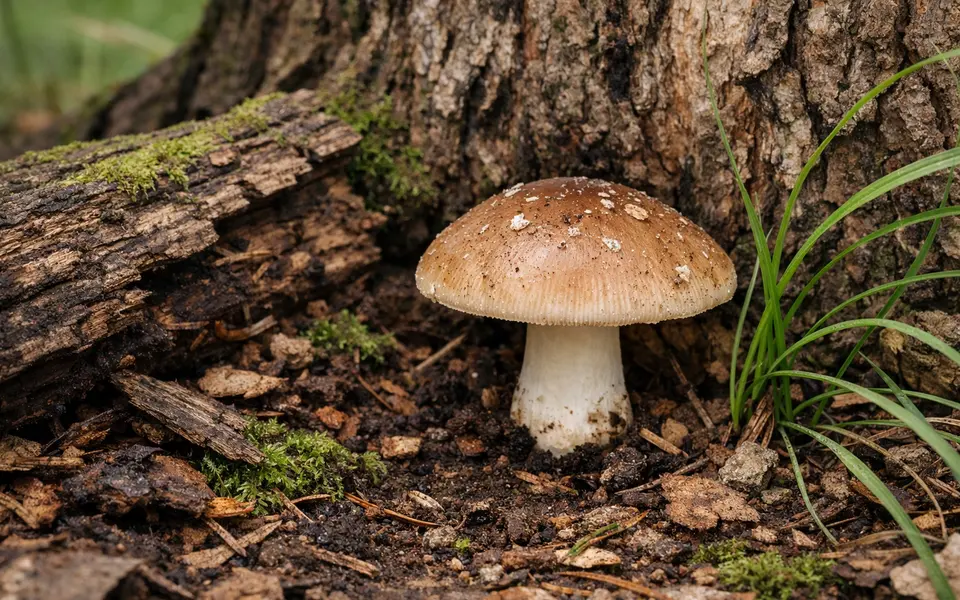
- Direct substrate contact (visible stem-to-wood or stem-to-soil) — highest reliability
- Nearby tree identity or clear leaf/needle litter — strong when obvious
- Growth pattern (clusters, shelves, rings, solitary) — robust, often diagnostic
- Micro-site details (moss, burned soil, pond edge, deeply shaded ravine) — important context
- Seasonal timing and local moisture signs — use to refine likely species sets
Weak mushroom habitat signals to treat cautiously
Color and surface texture are easily altered after rain, sun exposure, or by age; they are weak habitat signals when used alone. Soil color can mislead: dark, organic-rich soil in a landscaped bed may hide the presence of buried wood or imported mulch that the fungus is actually using. Likewise, caps with similar shades appear in very different ecological groups, so color without substrate context is risky.
Single-angle photos often hide the base. A stem photographed from above can make a stump-grown fungus look like it's growing from soil. Glare and shadow disguise crucial indicators such as a rooting base or a connection to buried wood. Never assume the apparent substrate from a single top-down image — try to get at least one lateral shot that includes the base and surrounding surface.
Proximity to trees is a weak signal unless the relationship is direct and visible. Many lawns and landscaped beds receive woody debris or roots beneath the turf; a mushroom appearing several feet from a trunk can still be feeding on buried roots or wood. Similarly, human activity moves mulch and compost, creating artificial habitats that mimic natural associations — these are common lookalike traps.
- Cap color and sheen — variable with moisture and age, avoid treating as decisive
- Single top-down photo — may conceal stem base or connection to substrate
- Mulch, buried wood, and landscaping — can create false tree associations
- Nearby plants seen at a distance — proximity alone doesn't prove partnership
- Size estimates without scale — misleading unless a ruler, coin, or hand is included
How to compare habitat clues step by step
Start by documenting substrate and context in a consistent order: (1) wide scene showing the tree or bed, (2) mid-distance showing the cluster or stump, and (3) close-ups of the stem base and any wood or soil contact. This photo sequence forces you to record the key habitat clues you will compare to field descriptions or species accounts.
Next, make a short checklist targeted to habitat: substrate type (hardwood, coniferous wood, leaf litter, turf, bare soil), tree or plant cues (needles, oak leaves, birch bark), and growth pattern (single, clustered, shelf, ring). Compare this checklist to descriptions in regional resources. For example, if your checklist shows dense clustering on a rotting hardwood stump under oak, restrict your comparison to fungi known to fruit on hardwoods and in that season.
Apply elimination logic: cross off species that require substrates or partners not observed in your photos. If a candidate species is described as strictly mycorrhizal with pines but your photos show broadleaf litter and no conifer signals, lower its probability. Conversely, if multiple independent clues point the same way (substrate, tree type, growth habit), those combined signals can make a small set of genera worth examining more closely.
Record uncertainty and possible confounders. Note if landscaping mulch, buried roots, or human disturbance could be influencing the apparent habitat. If multiple lookalikes remain after the habitat comparison, plan follow-up checks (better base photos, spore print, smell, or microscopic features) before adopting any identification from a single photo.
- Capture three framed photos: wide scene, mid-distance context, and base close-up
- Make a short habitat checklist: substrate, tree cues, growth pattern, micro-site
- Cross-reference checklist against regional species accounts or keys
- Eliminate impossible matches (wrong substrate or partner) before deeper comparison
- Log possible confounders (mulch, buried wood, recent landscaping) for follow-up
Using Fungio after you check habitat clues
Treat a field app like a research assistant rather than a final authority. After you collect habitat photos and checklist notes, open Mushroom Identifier: Fungio on your phone and use it to scan the photos as a first-pass to generate candidate matches. Use the app’s suggestions to guide which species descriptions and regional keys you consult next, not as the definitive answer.
Check the app’s confidence and the habitats it lists for each suggestion. If Fungio’s top suggestions share the same substrate and tree associations you observed, that increases the value of those suggestions as hypotheses to test. If the app’s top matches contradict the visible habitat (for instance, suggesting strictly conifer-associated species when your photos show clear deciduous leaf litter), treat that as a sign to re-evaluate the photos and capture additional base shots.
Follow a short verification loop: 1) re-photograph the stem base and the surrounding substrate with a scale; 2) compare gill, pore, or underside photos against the app’s candidate species; 3) consult a regional field guide or the Mushroom Visual Checklist: Common Clues, Lookalikes, and Next Steps for likely lookalikes. Use Fungio as a time-saving filter and keep the final identification as a provisional research note unless you confirm with multiple independent clues.
Always avoid relying on an app alone for decisions about edibility, toxicity, or other safety issues. Apps accelerate research and learning, but they cannot replace spore prints, microscopic examination, or consultation with an experienced local identifier when uncertainty persists.
- Scan habitat photos in Fungio as a first-pass researcher’s tool, not a final ID
- Compare app suggestions to your substrate and tree checklist — prefer matches that align
- If suggestions conflict with habitat, re-photograph the base and nearby substrate
- Use app output to prioritize which field descriptions or keys to consult next
- Never use an app result alone to decide edibility or safety
Related guides
Next step: scan your habitat clues with Mushroom Identifier: Fungio
After you photograph the substrate, tree cues, and the stem base, use Mushroom Identifier: Fungio on your phone as a first-pass filter to surface candidate species that match your habitat notes. Treat the app’s suggestions as research leads — compare them to field descriptions, re-check the base and surrounding substrate, and record any confounders like mulch or buried wood. If uncertainty remains, keep the result as a research note and consult a regional guide or an experienced local identifier before making safety decisions.

Frequently asked questions
Can mushroom habitat alone identify a species from a photo?
No. Habitat greatly narrows the list of plausible species by eliminating those that require different substrates or partners, but it rarely proves a species identity by itself. Many fungi share habitats and appear similar in photos. Use habitat to build a prioritized short list, then confirm with additional clues (stem base details, gill or pore photos, spore print, odor, or microscopic traits) or consult an expert when accuracy matters.
What habitat clues indicate a fungus is mycorrhizal versus saprotrophic?
Visible indicators: fungi fruiting directly from living roots at the tree base, forming regular associations beneath a particular tree genus, or appearing in undisturbed litter near living trees often suggest a mycorrhizal relationship. Mushrooms clearly emerging from dead wood, stumps, or heavily decayed logs are saprotrophic. Many cases fall between these extremes, so use multiple clues (substrate contact, tree type, and growth habit) rather than relying on a single observation.
How can I tell if mushrooms in soil are actually growing from buried wood?
Look for signs of buried wood in the immediate area: raised humps in the turf, fragments of bark or root at the soil surface, uneven ground where wood has decayed, or clusters aligned along a buried root line. Gently clearing a small patch of soil around the stem base (with care and permission) can reveal wood chips or root collars. If you can’t examine the base, get lateral shots of the stem disappearing into the ground — that visual is often the strongest non-invasive indicator of buried wood.
Are mushrooms in lawns more likely to be dangerous or edible?
Habitat alone does not determine edibility or toxicity. Lawns host a wide range of fungi — some edible, some toxic, and many of uncertain culinary value. Lawn species often grow from buried roots, old construction wood, or rich organic soil. Never assume a mushroom is safe to eat just because it appears in a familiar yard setting. Use habitat to form hypotheses, then seek multiple confirming traits and expert guidance before considering consumption.