
How to Tell If a Mushroom Is Poisonous: Visual Clues & Steps
Practical steps for how to tell if a mushroom is poisonous: photo clues, habitat checks, and safe next steps so you can decide when to verify with an expert.
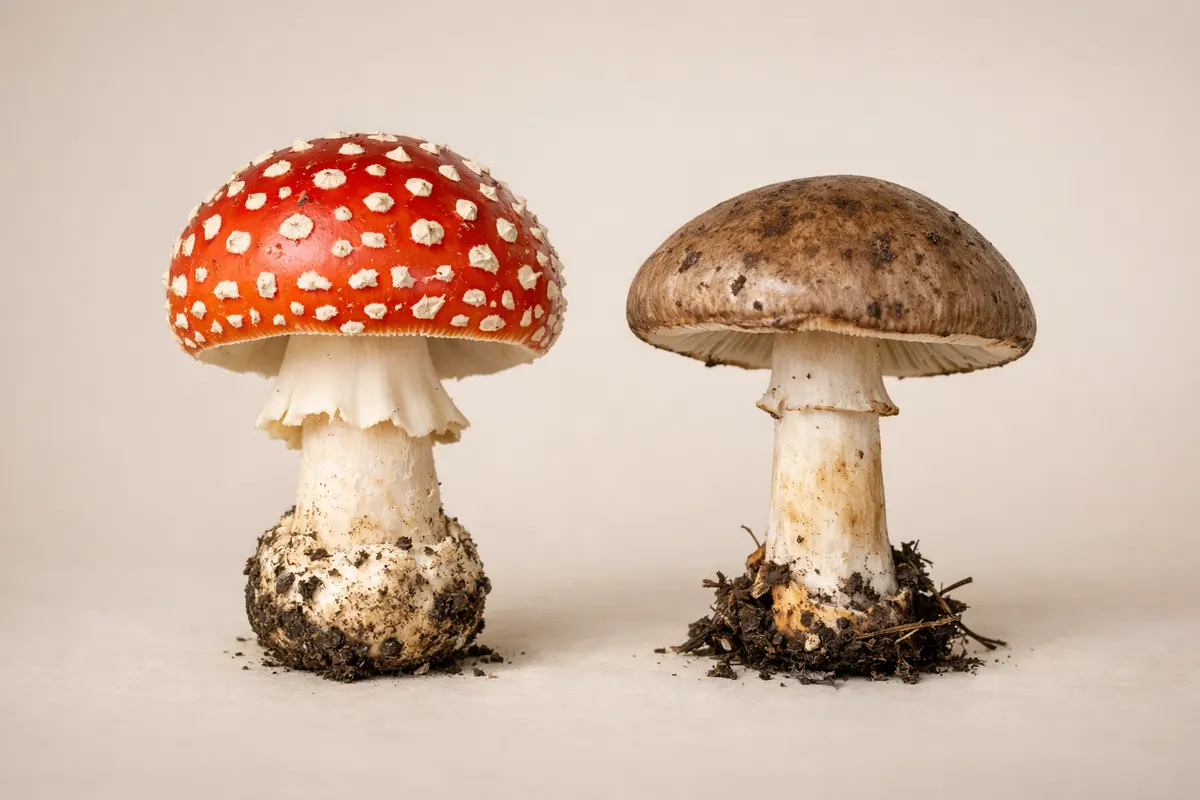
Quick answer: How to tell if a mushroom is poisonous
You cannot reliably tell if a mushroom is poisonous from a single casual glance. However, you can quickly gather visible clues and context that raise or lower suspicion. The fastest practical approach is to treat every unknown wild mushroom as potentially harmful until multiple, consistent indicators suggest otherwise.
Start by checking five core things you can see or record right now: cap shape and color, gill attachment or pores, stem features (bulb, ring, base), bruising or color changes, and where it was growing. Those immediate clues let you sort mushrooms into higher-risk groups (for example, many deadly Amanita species) and lower-risk groups, but they do not prove edibility.
If your goal is to decide whether to eat a mushroom, do not rely on a single photograph or an anecdotal trick. Use visual clues as the first pass, then follow a step-by-step verification workflow that includes comparing lookalikes, checking reliable region-specific sources, and seeking expert confirmation before you take any risk.
What it means to determine if a mushroom is poisonous
Determining whether a mushroom is poisonous is an evidence-based judgment, not a yes/no snap opinion. 'Poisonous' in foraging terms means the mushroom contains toxins that can cause illness or death when eaten, inhaled, or occasionally handled. Toxic compounds range from stomach irritants to powerful liver or neurotoxins, and the same-looking species can vary in toxin concentration by geography and age.
A visual identification narrows possibilities by matching a specimen to known species or groups. That match informs whether known toxins are likely present. But many edible and poisonous species look very similar — so-called lookalikes — and photos alone can miss microscopic or chemical differences required for a safe, definitive identification.
Because of those limits, the practical goal of 'how to tell if a mushroom is poisonous' is to collect the right clues and follow a verification path that suits the level of risk you face: none (do not eat), moderate (avoid and document), or low (trusted local expertise confirms). This approach prioritizes human safety over certainty from a single image.
Key clues
When assessing a mushroom for potential toxicity, focus on high-value visual features that experienced identifiers use to separate dangerous groups from benign ones. Photograph and note these features in good light and from multiple angles: the cap top and underside, stem base, any rings or volva, bruising reactions, and spore print color if you can safely make one.
Habitat and timing matter. Note whether the mushroom grew on wood, leaf litter, grass, disturbed soil, or near a specific tree species. Some toxic species are strongly associated with conifers or oak trees; others appear mostly on wood or in recent leaf litter. Seasonality and recent weather (dry vs. wet) also influence which species are active and which lookalikes are realistic.
Smell and taste are sometimes cited, but they are unreliable safety tests. Do not taste wild mushrooms to test edibility. Smell can be a helpful clue when combined with other features — for example, anise-like odor in some edible species — but it should never replace careful visual and contextual checks.
- Cap: shape (convex, umbonate, funnel), texture (scaly, slimy), and color changes with age.
- Underside: gills vs. pores vs. spines; whether gills are attached to the stem or free.
- Stem: presence of a ring (annulus), a bulbous base, root-like volva, color zones, and hollowness.
- Bruising: color changes when cut or bruised (blue, red, yellow) — useful but species-specific.
- Spore print: color collected on paper (white, brown, black, pink) is a high-confidence trait.
- Habitat: substrate (wood, soil, dung), nearby trees or plants, and whether it grew solitary or in clusters.
- Season and region: many poisonous species are seasonal and geographically constrained.
Step-by-step workflow to evaluate a suspicious mushroom
Follow a stepwise evaluation so you don't miss critical evidence. Work methodically: collect photographs and notes first, make non-destructive tests second, then compare to references before deciding whether to discard, quarantine, or escalate to an expert. This structure reduces the chance of misreading a single misleading feature.
Step 1 is immediate documentation. Take clear photos from above and below, of the stem base (carefully remove some substrate to reveal it), a close-up of the gills or pores, and a wide shot showing the surrounding habitat. Record location (GPS if possible), date, and any smells or color changes you observe.
Step 2 is basic non-destructive checks. Note bruising or latex exudate by gently pressing a small area with a clean tool; observe any color change over 5–15 minutes. If you opt to take a spore print, place the cap on contrasting paper (white and dark) under a container and leave 4–6 hours. Do not taste or swallow any sample.
- Document: photos above/below, stem base, habitat; note date and location.
- Non-destructive tests: bruising reaction, latex, and sticky/slimy cap texture.
- Spore print: use both white and dark paper to reveal color differences.
- Compare: use regional field guides, authoritative online databases, and lookalike charts.
- Verify: contact a local mycological society, extension service, or poison control for uncertain or high-risk finds.
- Act: if ingestion occurred, seek immediate medical or poison control help; if not, mark and avoid the area if you plan to forage there again.
Examples
Example 1 — Amanita lookalikes: Some deadly Amanita species (for example, Amanita phalloides and Amanita virosa) often have a white spore print, a bulbous stem base with a volva, and sometimes a ring. A white gilled mushroom with a sac-like volva at the base demands high caution because a mistaken identification here can be fatal. Photograph both the top of the cap and the buried base; a single cap photo often misses the volva.
Example 2 — Little brown mushrooms (LBMs): Many small brown agarics look similar and are notoriously tricky. Some contain gastrointestinal irritants or toxins that require microscopic analysis to separate. With LBMs, habitat and spore print color become especially important clues; if you can’t confidently separate species with those details, treat them as potentially unsafe.
Example 3 — False morels vs. true morels: True morels (Morchella spp.) have a continuous honeycomb cap with the cap attached to the stem at the base, while false morels (Gyromitra spp.) are lobed or brain-like and may contain gyromitrin, a hepatotoxic compound. Regional variation exists, and some edible-cooking traditions do not eliminate all risk, so when you see a brain-like cap or a chambered stem, favor caution.
- Amanita warning signs: white gills, ring + volva, and bulbous base — treat as high risk.
- LBMs: avoid eating unless you can match spore print, habitat, and microscopic features.
- Morel vs. false morel: cap attachment and cap texture are key; do not assume a resemblance is safe.
- Boletes: red-staining boletes can be toxic; pores (not gills) and bruising color are diagnostic.
- Shelf fungi and polypores: most are inedible but not acutely toxic; note substrate and pore surface.
Limitations
Photos and quick checks have important limits. Some species are distinguishable only by microscopic features (spore size/shape, cystidia) or by chemical tests. Regional variation means a species that is harmless in one place can present differently elsewhere, and hybrid or poorly-known species add further uncertainty. Do not assume a confident label from an automated tool or a single online post is sufficient for deciding to eat a mushroom.
If any of these conditions apply, you should seek verification from a human expert: the mushroom resembles a high-risk group (Amanita, Galerina, some Gyromitra), the specimen is old or degraded, different sources disagree, or you plan to consume it. Local mycological societies, university extension services, and trained foragers offer higher-confidence confirmations than anonymous internet identifications.
In cases of ingestion or suspected poisoning, do not wait for identification. Contact local poison control or emergency services immediately and, if possible, preserve photographed evidence and any remaining specimen in a sealed bag for medical or laboratory analysis. Medical professionals treat symptoms and can use species identification later to tailor treatment, but initial care is driven by clinical presentation.
- Microscopic and chemical tests: necessary for many definitive IDs; photos may be insufficient.
- Geographic variation: regional guides matter—use local references when possible.
- Degraded specimens: older or insect-damaged mushrooms lose key features and are harder to ID.
- Automated tools: helpful first pass but not a substitute for expert confirmation for high-risk finds.
- If ingested: seek immediate medical/poison-control help; preserve evidence and specimen.
Related guides
Need a faster second opinion? Use the Poisonous Mushroom Check
If you want a quick secondary check after collecting photos and notes, try the Poisonous Mushroom Check tool at https://mushroomidentification.app/tools/poisonous-mushroom-check. Use it as a fast way to surface likely warning signs from your images and the habitat details you recorded — then follow up with a local mycologist, extension service, or our in-depth guides if the tool flags a high-risk match. The app-based check is one step in the verification workflow, not a substitute for expert confirmation when safety is at stake.
Take the next step →Frequently asked questions
Can you tell if a mushroom is poisonous by its color?
Color alone is a poor predictor of toxicity. Some bright-colored mushrooms are harmless, while many deadly species are plain white or brown. Color should be used alongside structural features (gills vs. pores, stem base, rings/volva), habitat, and spore print to form a reliable assessment.
Is it safe to rely on online ID or phone apps to decide whether to eat a mushroom?
Online IDs and identification apps are useful for a quick, preliminary idea, but they are not definitive for high-risk decisions like eating. These tools can mislabel lookalikes, miss regional variants, or be fooled by poor photos. Use them as a first pass, then verify with local experts or authoritative regional guides before consuming any wild mushroom.
What should I do if someone ate a mushroom and is now ill?
If ingestion and illness are suspected, contact your local poison control center or emergency services immediately. Provide as much information as possible: time of ingestion, symptoms, photos of the mushroom, and any remaining material. Do not wait for a perfect identification; medical teams will treat symptoms and can use specimen identification later to refine care.
Are there harmless tests I can do in the field to rule out poisonous mushrooms?
Yes — several non-destructive checks can increase confidence without risking harm: take clear photos of multiple features, make a spore print, note habitat and nearby plants, and observe bruising reactions. Avoid tasting, smelling intensely with your mouth, or cutting into mushrooms that could be toxic. For high-stakes decisions, these field checks should be followed by expert verification.