
Magic Mushroom Identifier: Photo Clues and Next Steps
Learn what a magic mushroom identifier can and cannot tell you from photos, how to document a find, and why a suggested match is not a safety decision.
Quick answer: what can a magic mushroom identifier tell you?
A magic mushroom identifier may suggest names from a photograph, but its output is a starting point for discussion. A picture can document visible features; it cannot measure psilocybin content or establish whether a mushroom is safe to consume. A confident label on a screen does not change those limits. Do not use an app result, a matching photograph, or this article to decide whether to eat a wild mushroom.
The phrase “magic mushroom” describes a common interest in psychoactive fungi, not one species with a single dependable appearance. A search result can therefore mix different species, illustrations, commercial photographs and unverified labels. Visual similarity between your photograph and one of those results is not independent confirmation. The useful question is what information is missing, rather than whether the closest-looking image supplies permission to act.
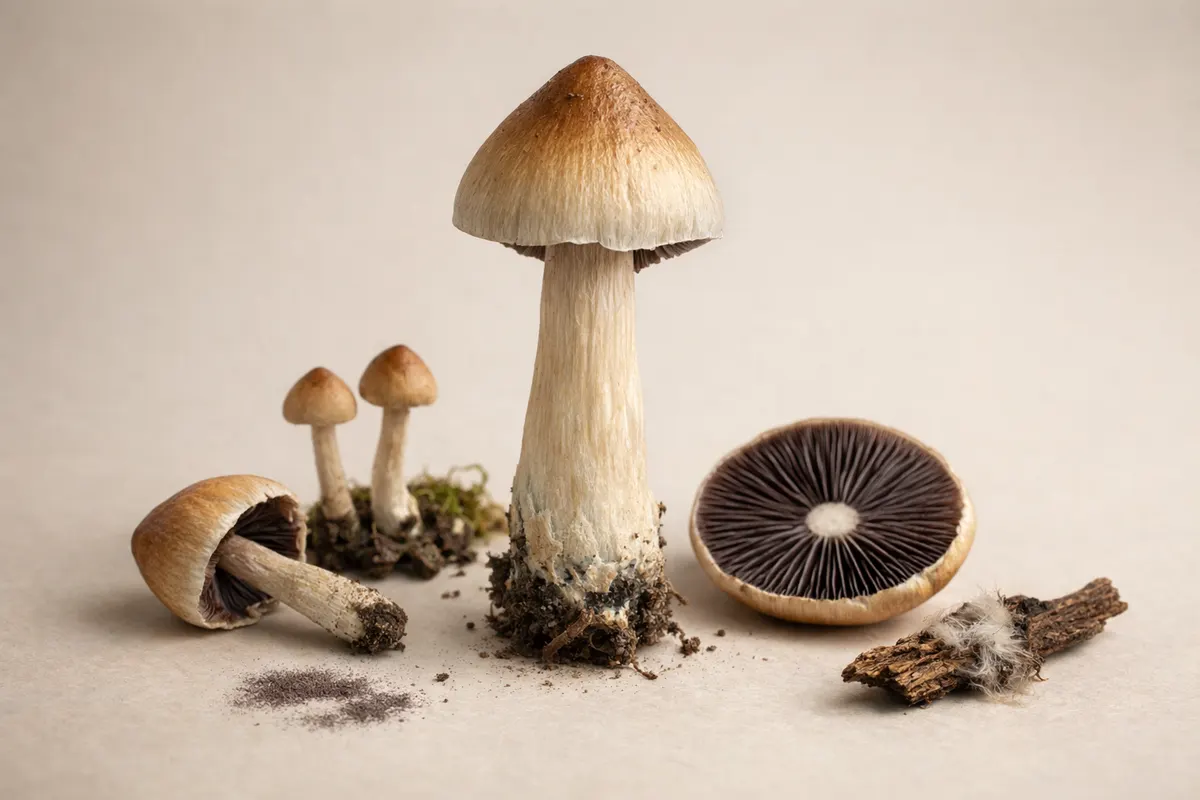
This guide explains how to interpret an identifier’s output and prepare an observation record for review. It does not provide a collecting guide, a chemical test, or a checklist for clearing a specimen for consumption. The hero image is an AI-generated illustration of mushroom structures; it is not a photographed, verified specimen and should not be used as identification evidence.
- A suggested name is a hypothesis to review, not a confirmed identification.
- Photographs do not measure psychoactive compounds, dose or toxicity.
- Keep a record of uncertainty instead of replacing it with an app confidence label.
Separate the photograph, the suggested name and the decision
An observation and an interpretation are different kinds of information. “The cap appears brown in this photograph” records something visible. “This is a particular species” interprets that observation. “It contains a particular compound” makes a further claim that a photograph has not measured. Keeping those statements separate helps prevent an attractive result card from doing more work than its evidence supports.
When reading an identifier result, look for what the product actually supplies. It might show a possible name, related images or explanatory text. None of those features demonstrates that this particular result has been independently checked. A confidence percentage, where one is displayed, should not be read as a percentage chance that a mushroom is safe to eat. Different tools may also express uncertainty in different ways.
The Alberta Mycological Society cautions against relying on AI mushroom identification and explains that important identification features may be unavailable to image-based systems. That warning is a reason to preserve the original observations and seek knowledgeable review. It does not mean that a second app, a clearer crop, or repeated agreement among search results turns the same limited evidence into proof.
- Observation: what the image or your notes actually record.
- Interpretation: the name or group proposed by a person or tool.
- Unanswered question: what would require independent assessment or measurement.
Document a find without turning a checklist into a test
For an observation record, photographs of the cap, underside, stem and surrounding setting can show different information. Note which parts are visible and which are obscured. A recognizable scale reference can help a reviewer understand the photograph, while the date and general location give context. These are ways to document a find; they are not a set of conditions that makes an identification reliable or a specimen safe.
Keep pictures from different mushrooms clearly separated. A cap photographed in one place and an underside photographed elsewhere should not be presented as two views of the same specimen. If you are unsure which images belong together, say so. Preserve the original files and identify any edited versions. Changes to color, contrast or background can remove context that a reviewer would otherwise notice.
Record uncertainty in plain language: the base was hidden, the underside was out of focus, or the object was already damaged. Do not fill a missing field by copying the description of the species suggested by an app. Doing that makes the record appear to support a result when the details actually came from the result itself.
Neither bruising, a spore print, a cap shape nor a habitat note is a home safety test. This article does not ask you to break, taste or otherwise test a mushroom to resolve an app result. A specialist can explain what evidence is relevant to their assessment. If the question concerns suspected ingestion, seek professional medical or poison advice promptly rather than delaying while you complete photographs or identification tasks.
Review the result and prepare a useful question
Start by writing down the question you need answered. Learning the names of visible structures is different from obtaining a species determination, and neither is the same as making a medical decision. A photo identifier may help you find terminology to research, but it should not decide the consequences of a result for you. Keep the purpose of the review visible in your notes.
Next, save the output alongside your original observations. Record the suggested name exactly, including qualifiers such as “possible,” and preserve any alternatives the tool displayed. If an explanation cites a feature you cannot see, mark it as unverified. If two tools disagree, record the disagreement; choosing the answer you prefer does not resolve it.
For general identification questions, a regional mycological society or experienced identifier may explain how they accept observations and what they can responsibly conclude. Provide the original images, your notes and the fact that an app suggested a name. Ask what remains uncertain and whether the available material is sufficient for any conclusion. A responsible response may be that the mushroom cannot be identified from that record.
Do not treat a casual online reply as permission to consume a specimen. If someone may have eaten an unidentified mushroom, the immediate question belongs with a medical professional or poison service. Identification may support their assessment, but waiting for an app, social-media reply or completed observation record is not an appropriate substitute for seeking that help.
- State the question before interpreting the result.
- Keep observations separate from app-generated descriptions.
- Preserve disagreements and missing information for the reviewer.
- Accept an unresolved result when the evidence is insufficient.
Examples of uncertainty, without guessing a species
Example one: a clear overhead photograph shows a small brown cap, but no underside or stem base. The useful conclusion is that those views are missing. Assigning a species from the cap alone would add a claim the record does not establish. A polished photograph can still be an incomplete photograph, and a recognizable silhouette does not supply the unseen structures.
Example two: several mushrooms appear together in a photograph. The identifier proposes one name for the scene. That result does not establish that every visible mushroom belongs to the same species, or that a separate mushroom nearby shares the identification. Keep each observation distinguishable and make the limits of the photograph explicit when requesting review.
Example three: one app produces a confident match while another produces several different suggestions. This is a reason to preserve the uncertainty, not to average the answers or keep trying until a preferred name appears. Compare the explanations with what is actually visible, then ask a knowledgeable reviewer whether the original material supports any determination.
Example four: an image resembles the illustration used on this page. That resemblance has no evidential value for identifying a real specimen: the image was generated for editorial presentation. The same distinction matters with stock photographs and unlabeled search images. Reference material is only useful when its provenance and purpose are clear, and resemblance alone does not establish identity, chemistry or safety.
Limits and sources to read before relying on a result
A complete observation record and a reliable conclusion are not interchangeable. More photographs can make more features available for discussion, but they do not justify an invented “high confidence” tier. Some questions remain unresolved even with good images. This article gives no accuracy score for Fungio or another identifier because no product-specific validation evidence is being presented here.
Poison Control warns that mushroom lookalikes can fool experienced people and that symptoms of poisoning may be delayed. The Victorian Chief Health Officer’s mushroom advisory also states that there is no home test for distinguishing safe or edible mushrooms from poisonous ones. Their guidance supports a clear boundary: do not use an image match or a series of household checks as a consumption decision.
The sources below explain the identification and poisoning limits discussed here. They do not validate the accuracy of this website’s tool. The Alberta statement addresses mushroom identification apps; the health and poison sources address the risks of misidentification and suspected ingestion. No claim about a particular app’s performance should be inferred from their inclusion.
Alberta Mycological Society, “Mushroom ID Apps — AMS Statement”: https://www.albertamushrooms.ca/2021/07/05/mushroom-id-apps-ams-statement/
National Capital Poison Center, wild mushroom warning: https://www.poison.org/articles/wild-mushroom-warning
Victorian Department of Health, poisonous mushrooms advisory: https://www.health.vic.gov.au/health-advisories/poisonous-mushrooms-growing-victoria
Related guides
Continue with mushroom observation guides
Use this site’s guides to learn the vocabulary of cap shapes, gills and other visible structures before reading a suggested identification. Fungio’s identification tool at https://mushroomidentification.app/tools/free-mushroom-identifier can be one source of suggestions for discussion, but it does not establish chemistry, toxicity or safe consumption. Keep those limits alongside any result.
Take the next step →Frequently asked questions
Can a magic mushroom identifier prove a mushroom contains psilocybin?
No. A photograph does not measure chemical contents. A suggested species name is also not a chemical measurement of the specimen you photographed. Do not infer psychoactivity, concentration, a usable dose or safety from an app match, appearance or color change.
Does a high-confidence result mean the mushroom is safe to eat?
No. A confidence label is not a consumption clearance or an independent assessment of toxicity. Clear photographs and agreement between tools do not change that boundary. Do not use a photo identifier or this article to decide whether to eat a wild mushroom.
What should I include when asking for help with an observation?
Provide the original photographs and clearly distinguish images of different specimens. Include the date, general location and observations you actually made. State what is missing or uncertain, and disclose any app-generated suggestion. Ask the reviewer what the available evidence can support rather than asking them to confirm a preferred answer.
What if someone may have eaten an unidentified mushroom?
Seek professional medical or poison advice promptly; do not wait for an identifier result or symptoms. Poison Control and the Victorian health advisory explain that symptoms can be delayed. Photographs and observation details may assist the professionals, but collecting them should not delay getting help.